An electric foot callus remover is a handheld tool with a spinning, grit-coated head that sands away thick, hardened skin on your heels and soles. For most people, the Amopé Pedi Perfect is the safest all-rounder. Want the same result for less? The PRITECH is the budget pick, and it works in the shower. Use any of them gently, once or twice a week. They smooth your feet fast, but they can’t fix what causes the calluses in the first place.
Top picks at a glance
| Device | Best for | Power | Water use | Head type |
|---|---|---|---|---|
| Amopé Pedi Perfect | Overall, easy upkeep | Battery (check model) | No | Diamond-crystal roller |
| PRITECH Electric Remover | Budget + shower use | Rechargeable | Yes (water-rated) | Mineral roller |
| Care Me Powerful File | Thick, stubborn calluses | Rechargeable | No | Coarse mineral rollers |
| SaxVon Foot Sander | Precision, edges and spots | Rechargeable | Splash only | Sanding discs (mild + coarse) |
| Amopé Pedi Perfect Wet & Dry | A trusted brand for the shower | Battery (check model) | Yes (water-resistant) | Diamond-crystal roller |
Prices and current ratings shift constantly. Always check the live listing before you buy.
Do they actually work?
Short answer: yes, on the rough skin you can see. The spinning head buffs away dead, built-up layers far faster than a pumice stone, and most people notice smoother heels after a single pass. For week-to-week upkeep, they’re genuinely great.
Here’s the catch nobody likes to hear. These tools work on the surface. They don’t pull a callus out by the root, because the root isn’t the skin at all — it’s pressure. So the smoothness is real, but it’s a rental, not a purchase. Keep up the routine and fix what’s pressing on your foot, or the hard skin comes right back.
So what is a callus, really?
A callus is a patch of thick skin your body builds on purpose. Anywhere it takes repeated rubbing or pressure — from walking barefoot, standing all day, or shoes that don’t fit — it lays down extra layers of keratin, the same protein in your nails, as a kind of armor.
That “on purpose” part matters more than most guides admit. Sand the skin off, and the pressure point is still there. Your body just rebuilds the callus, sometimes thicker and faster than before. That’s why trying to scrape your heels perfectly bare backfires. The smart goal is to bring the hard skin down and keep things comfortable — not to erase it.
How an electric foot callus remover works
Every one of these tools is built around a rotating head coated in fine mineral or crystal grit. A small motor spins it, and you glide it over rough skin while the grit shaves off thin layers of dead cells. Light, steady contact does the job. Bearing down harder doesn’t speed things up — it just risks your skin.
Beyond that, the features are familiar. You’ll find rechargeable or replaceable batteries, swappable heads in different grits, two or more speeds, and sometimes an LED light or a water-resistant shell. The better units add a pressure-sensitive motor that backs off when you push too hard, which is a real safeguard against overdoing it.
The 5 best electric foot callus removers in 2026
1. Amopé Pedi Perfect — best overall
If you ask around, Amopé is the name that keeps coming up, and the reputation is earned. The diamond-crystal roller handles everyday roughness without drama, the two speeds let you ease in gently, and it’s one of the most-reviewed foot files on Amazon — so you’re not gambling on a no-name gadget. Spare rollers are easy to find when yours wears down.
Love it for: dependable, low-fuss maintenance.
Watch out for: the standard model isn’t waterproof, and rollers do wear out with heavy use.
Skip it if: you want to exfoliate in the shower, or your heels are badly neglected and need more muscle.
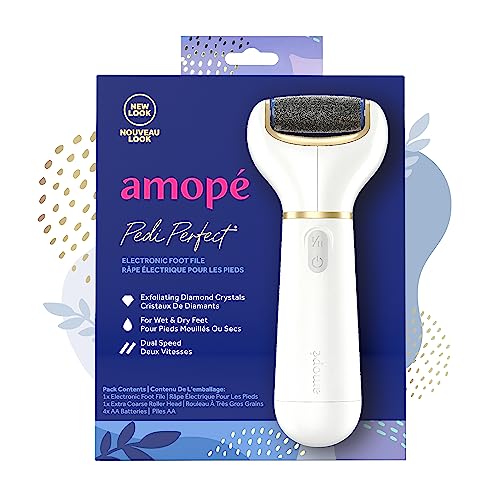
- The Amopé Pedi Perfect Electronic Foot File gently & effectively buffs away your thick, hard skin to reveal touchably so…
- Includes Extra Coarse roller head with diamond crystals to effortlessly & effectively remove very hard skin. Roller head…
- Splashproof design, however intended to be used in dry settings. For use on wet or dry skin.
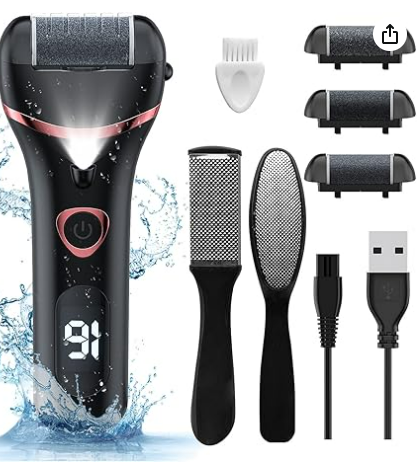
2. PRITECH Electric Feet Callus Remover — best budget
The PRITECH is proof you don’t have to spend big. It’s rechargeable, rated for wet use so it’s happy in the shower, and it throws in a built-in light and two speeds. It also eases off the pressure on its own to protect your skin, which is a nice touch at this price.
Love it for: shower-friendly use, USB charging, and a wallet-friendly price.
Watch out for: a slightly bulky body, and replacement rollers that can be harder to find.
Skip it if: you want a slim, premium feel or a guaranteed long-term roller supply.
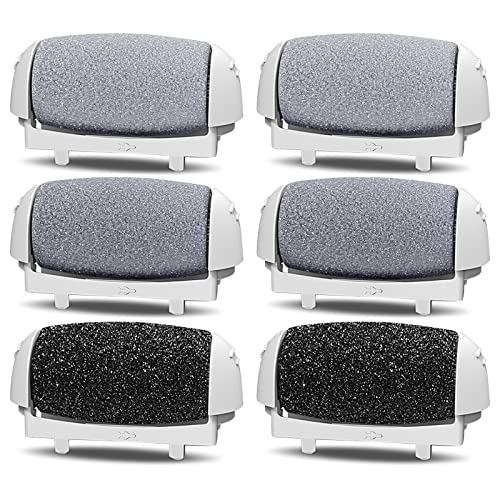
- 6 REPLACEMENT ROLLERS – Designed washable suit to perfectly fit PRITECH Electronic Pedicure Foot File.
- 3 Different Coarse Levels: Extra coarse for effectively remove even toughest hard skin; Regular coarse for softens & smo…
- Safely And Effectively: Those velvet smooth replacement rollers feature curved design and fits your feet perfectly. Safe…

- FAST & RECHARGEABLE PRO FOOT CARE CALLUS REMOVER SET: Efficient foot pedicure tool to support plug-and-play, simply rech…
- WHOLE BODY WATERPROOF: The dry skin electric foot callus remover has an IPX6 waterproof design, allowing it to be rinsed…
- POWERFUL,SAFE and FAST: Two-speed Replacement. 1900/2200 turns of scientific speed. Three types of rollers have varying …
3. Care Me Powerful Electric Foot File — best for thick, stubborn calluses
When heels have been ignored for a while, this is the one I’d reach for. The Care Me spins around 40 times a second and comes with coarse mineral rollers made for serious buildup. You’ll get roughly 40 minutes of use per charge, and it takes about eight hours to top up fully.
Love it for: raw power on cracked, neglected heels.
Watch out for: it’s not made for wet use, it runs louder, and it can feel like too much on thin or sensitive skin.
Skip it if: your skin is delicate, or you only need light touch-ups.
- 💪 Unparalleled Power & Performance – Engineered with a high-torque motor running at an incredible 3,600 RPM, this powerf…
- 👍Fast Charging & Long-Lasting Battery – Features a premium rechargeable lithium battery that fully charges in just 2 hou…
- 💎Durable Diamond-Coated Rollers – Comes with 3 ultra-coarse grinding heads (1 is pre-installed) made with finely ground …
4. SaxVon Foot Sander — best for precision
Instead of one wide roller, the SaxVon uses small sanding discs in mild and coarse grits, with a single button to switch speeds. That disc design gives you more control on edges, corners, and the small stubborn spots a big roller tends to skate right over.
Love it for: targeted control and easy one-button operation.
Watch out for: it’s slower across large areas, and the discs need replacing over time.
Skip it if: you want to cover the whole sole quickly.

- Convenience Meets Comfort: Designed with ease and accessibility in mind, SaxVon’s electric foot callus machine is the ul…
- Professional-Level Smoothness: SaxVon’s electric foot callus machine is commonly used by nail salons and luxury spas. Th…
- Mild and Coarse Sanding Attachments: This foot callus machine comes with 12 sanding attachments- 6 Mild and 6 Coarse. Th…
5. Amopé Pedi Perfect Wet & Dry — best trusted-brand shower option
Like the idea of Amopé but want to exfoliate while you shower? The Wet & Dry version is water-resistant and built for damp skin, keeping the same diamond-crystal roller that made the brand a staple.
Love it for: a name you can trust, in a water-resistant build.
Watch out for: it costs more than the budget picks, and softened shower skin sands away faster, so go easy.
Skip it if: money’s tight — the PRITECH covers wet use for less.

- Electronic Foot Care: Effortlessly smooth and exfoliate your feet with this electronic foot file, offering a modern and …
- Mixed Refills Included: Comes with 2 refills – one extra coarse for tough calluses and one exfoliating brush for gentle …
- Stainless Steel Construction: Built to last with durable stainless steel material, ensuring long-lasting performance and…
How to choose: what actually matters
Start with motor strength, because a weak one stalls against thick skin and turns a quick job into a wrestling match. Look for steady power and at least two speeds, with a low setting for tender spots.
Battery type comes next. Rechargeable models cost a bit more upfront but stay consistent and save money over time, and they’re better if you travel. After that, think about roller quality and how much replacements cost, since worn grit means weak results. Decide whether you need a water-rated body for the shower, and lean toward a pressure-sensitive motor that stops you over-sanding. Last, the small comforts add up: a non-slip grip, quiet operation, and a brand that actually sells replacement parts.
How to use one without hurting yourself
You don’t need any training, just a little patience. Work on clean, dry feet unless your tool is rated for wet use. Hold it at a slight angle and glide it slowly over the rough spots — two to three minutes per foot — and let the grit do the work. The second skin starts feeling warm or tender, stop.
Then wipe away the dust and moisturize. A good foot cream right after locks in water and slows the next round of buildup. After that, put the tool away for a few days. Short and gentle beats one aggressive scrape, every single time.
Should you soak your feet first?
This one’s a genuine trade-off. Soaking softens skin and makes light buffing easier. But soft skin also sands away faster, so it’s easier to take off too much before you notice. If you do soak, keep it brief and stay on the lowest speed. Plenty of people actually get better control working on dry skin with a decent device.
Safety, side effects, and who should sit this one out
Used gently and as directed, these tools are safe for most healthy adults. The trouble starts with overuse and with using them on skin that isn’t a candidate. Go too often or too hard and you can thin the skin, leave it sore, or kick off irritation that makes calluses rebuild even faster.
A few rules I’d treat as non-negotiable: never use one on broken, cracked-open, inflamed, or infected skin. Don’t share yours — that’s how bacteria and fungus travel. Clean the head after every use. And if you’re new or your skin is delicate, start on the lowest speed.
Some people shouldn’t DIY this at all. If you have diabetes, peripheral neuropathy, or poor circulation, check with a podiatrist before using any callus tool. When sensation is reduced, you may not feel that you’ve gone too far, and slower healing can turn a tiny nick into a real infection or ulcer. That’s not a throwaway caution — foot wounds are a leading cause of serious complications in diabetes.
What podiatrists actually use — and why callus shavers are “illegal”
Here’s where home tools and clinical care split. For a significant callus, a podiatrist might carefully pare the skin with a sterile surgical blade — a process called debridement — in a clean, controlled setting. Just as important, they go after the cause: better footwear, padding, or custom orthotics that take pressure off the spot so the callus stops coming back. They’ll also point you to keratolytic creams, like urea or salicylic acid, that soften thick skin over time.
So why do people say callus shavers are illegal? Razor-style callus shavers, rasps, and “cheese-grater” files — including the well-known credo blade — are banned for salon use in many US states. Regulators class them as a health hazard because a blade can slice healthy skin, cause bleeding, and invite infection, and an untrained hand can’t judge safe pressure. Several state cosmetology boards ban them outright in professional settings. Your takeaway: leave blade tools alone at home, and let an electric file or a professional handle the heavy lifting.
What to pair with your device for longer-lasting results
Smoothing is only half the routine. What you do afterward decides how long it lasts.
- Urea foot creams (around 10–25%) soften and hold moisture in thick skin, and dermatologists often recommend them for rough heels.
- Shea butter or plain coconut oil overnight, under cotton socks, deeply rehydrates.
- Moisture-locking sleep socks trap all that hydration while you sleep.
Keep your feet dry through the day, wear cushioned shoes that fit, and moisturize daily. Hydrated skin fights off buildup, which means less sanding down the line.
How often should you use one?
Once or twice a week is plenty for most feet, and every week or two for light upkeep. More than that, and you risk thinning the skin and — the irony — speeding up regrowth. Consistency wins over intensity here.
The honest read
Electric foot callus removers earn their spot in the cabinet. They’re faster, cleaner, and a whole lot safer than blade tools, and they deliver real, visible smoothness in minutes. The Amopé Pedi Perfect is still the one I’d hand a friend who just wants reliable results, the PRITECH is the value champ, and the Care Me is what you grab when heels are truly neglected.
Just stay clear-eyed about what they do. They manage hard skin; they don’t cure it. If your calluses are painful, cracking deep, or roaring back no matter what you try, that’s a footwear-and-pressure problem, and a podiatrist will help more than any gadget ever could. And if you’re living with diabetes or nerve issues, that visit isn’t optional. Smooth feet are nice. Healthy feet are the point.
FAQs
Do electric callus removers actually work?
Yes, on surface-level rough skin. They buff away dead skin fast and smooth heels in minutes, but they don’t remove a callus at the root, so results only last with regular use and better footwear.
What is the best electric foot callus remover?
For most people the Amopé Pedi Perfect is the best all-rounder, thanks to its reliable roller, two speeds, and easy-to-find replacements. The PRITECH is the best budget option and works in the shower.
What do podiatrists use to remove calluses?
A podiatrist may pare thick calluses with a sterile surgical blade in a clinical setting, then treat the cause with padding, footwear changes, or orthotics, plus keratolytic creams like urea or salicylic acid.
What are the side effects of an electric callus remover?
Overuse can thin the skin, cause soreness, irritation, or sensitivity, and make calluses rebuild faster. Using one on broken or infected skin can lead to infection.
Should you soak your feet before using an electric callus remover?
You can, and it softens skin, but soft skin sands away faster and is easier to over-remove. If you soak, keep it brief and use the lowest speed. Many people prefer dry use for control.
Who should not use an electric foot device?
People with diabetes, peripheral neuropathy, or poor circulation should check with a podiatrist first. Anyone with open wounds, infections, or inflamed skin should wait until it heals.
Why are callus shavers illegal?
Razor-style callus shavers and graters, like the credo blade, are banned for salon use in many US states because the blade can cut healthy skin, cause bleeding, and lead to infection in untrained hands.
What is inside a callus?
A callus is thickened, hardened skin made mostly of keratin. Your body builds it to protect areas that face repeated pressure or friction.
How often should you use an electric foot scrubber?
Once or twice a week for rough feet, and every week or two for maintenance. Frequent aggressive sessions can damage skin and speed up regrowth.
Can I use one on wet skin?
Only if the device is rated for wet use — check the IP rating. Many are splash-resistant but not fully waterproof, and water can damage units that aren’t rated for it.
Will it remove thick calluses in one session?
No. Heavy buildup needs several gentle sessions a few days apart, or professional care. Trying to take it all off at once damages healthy skin.
Are electric callus removers better than a pumice stone?
For speed and effort, yes — they smooth skin faster with far less work. A pumice stone is gentler and cheaper for very light upkeep.
Do I need to replace the roller heads?
Yes. Grit wears down, so rollers and discs need occasional replacing to keep working well. Factor that cost into your choice.
Why do my calluses keep coming back?
Because the pressure that caused them is still there. Until you change your footwear, add cushioning, or fix the pressure point, the callus rebuilds.
About the author
Md Shahinuzzaman writes about beauty and personal-care tools for TattooAndStyle.com, with a focus on honest, safety-first guidance. This guide was researched against manufacturer information, retailer listings, and US cosmetology and podiatry sources, and reflects aggregated buyer feedback rather than paid placement.